

Mizuno has been making things for sport since 1906, which makes it older than every brand written about here except Saucony. Its running shoes are built on an idea nobody else stayed with: that the work a midsole has to do is better done by a shaped piece of plastic than by more foam. In Britain it is the brand the club runner wears and the high street has never heard of.
1906: two brothers, a shop and a borrowed sport
In 1906 Rihachi Mizuno and his younger brother Rizo opened Mizuno Brothers Ltd in Osaka, selling western goods. Rihachi had watched American baseball and decided the game had a future in Japan; within a year the shop was making baseball kit, and on the company’s own account it was producing track and field spikes by 1928.
That order matters, because it never changed. Mizuno grew up as a sports-goods company rather than a shoe company, and it still is one: the golf irons and the baseball gloves are not a sideline that got out of hand, they are the other half of the business. Running shoes are one counter in a much bigger shop, which is part of why the brand has never behaved like a trainer label.
The wave, and why it is a piece of plastic
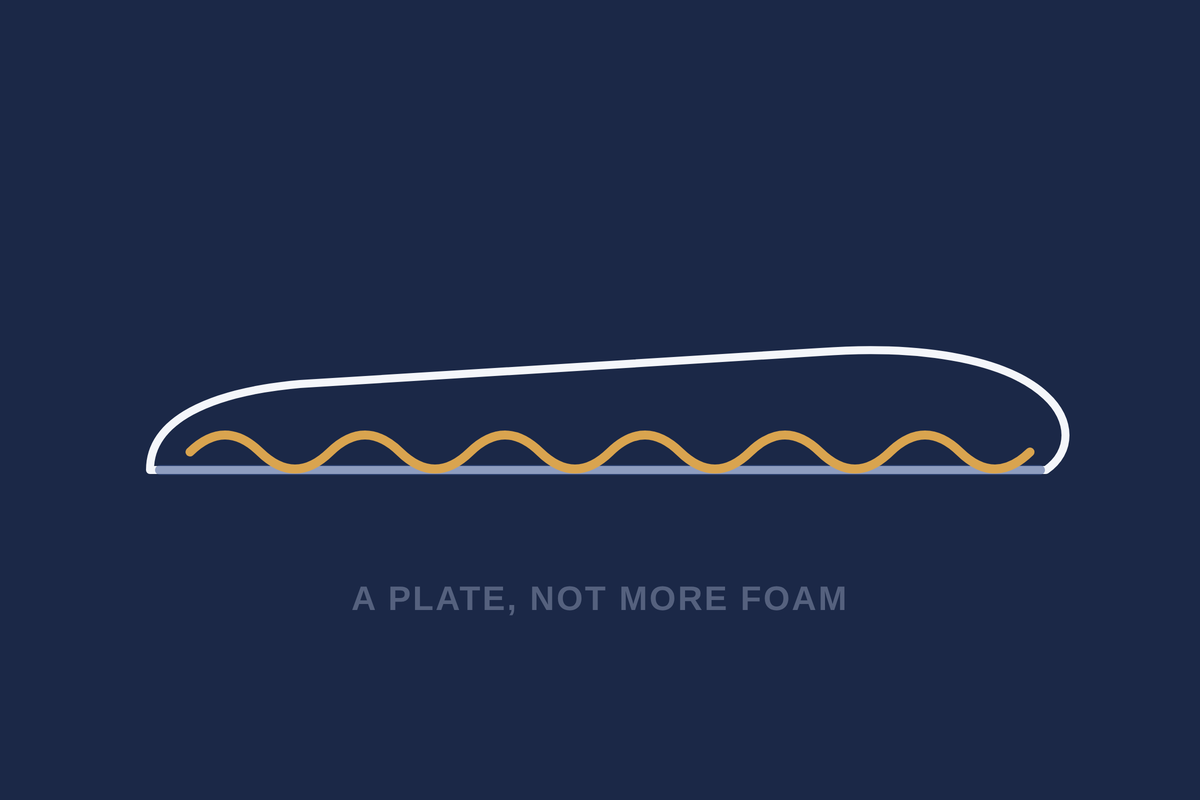
Almost everyone else controls a shoe with density. If a foot rolls inwards too far, the usual answer is a firmer wedge of foam under the arch pressing back – that is the family of ideas the stability technologies belong to. Mizuno’s answer is geometry. A corrugated plastic plate, the Wave, sits between the layers of the midsole and spreads a landing sideways along its ridges instead of letting it drop straight through.
The Wave Rider arrived in 1997 and the company marked the line’s twentieth birthday in 2017, so the plate has now outlasted most of the foams it was competing against. What it claims is stability without the firm wedge and cushioning without a tall stack of soft foam. Whether a plate does that better than a good foam is an argument runners have been having for a quarter of a century. What is not arguable is that it feels different, and that the difference is immediate.
Firm, through a decade that went soft
The 2010s were the decade the industry went up and soft. Hoka made the oversized midsole respectable, everyone else followed, and a shoe that did not feel plush started to look old-fashioned. Mizuno largely did not follow. The shoes grew, because every shoe grew, but the ride stayed firmer and more connected than the fashion of the moment, and the brand lost some ground for it.
What it kept was the people who had already decided they liked that. A firm shoe tells you more about the ground, holds its shape better under a heavier runner, and does not wallow when you are tired. A soft shoe is kinder on a recovery run and sells better in a shop, because the shop test is a walk across carpet and softness wins that every time.
Buying one, in Britain
Mizuno is a specialist shop’s brand here: stocked where people are measured and rarely where they are not. The fit runs narrower through the middle than most American brands, which suits some feet and immediately rules it out for others – if a wide forefoot is why your last pair hurt, start with the size and fit page rather than the brand.
The honest summary after a hundred and twenty years is that Mizuno is not trying to sell you a sensation. There is no visible window, no pillow, no word on the box that means nothing. There is a plastic wave you cannot see, doing a job you can only judge by running in it, from a company that also made the glove.
Questions I get asked about Mizuno
Is the Wave plate the same thing as a carbon plate?
No, and the jobs are opposite ends of the shoe’s brief. A carbon plate is there to stiffen the shoe along its length so that less of your push is lost bending it – it is about propulsion, and it belongs with racing. The Wave is a shaped plastic plate across the shoe that spreads the landing and holds the foot level. One is for going faster, the other for landing steadier, and a shoe can have either without the other.
Why do Mizuno shoes feel firmer than everything else?
Because the stability comes from the plate rather than from a thick, soft stack, the foam around it does not have to be as deep. You stand closer to the ground and you feel more of it. Whether that is a drawback depends entirely on what you want: it is an advantage on a tempo run and on uneven ground, and a disadvantage on an easy hour when your legs are already sore.
Is Mizuno really a baseball company?
It is a sports-goods company that has made baseball equipment since about a year after it opened, and still does. The running shoes are a serious part of the business rather than a souvenir, but they were never the whole of it – which is a different history from Nike or Hoka, where the running shoe is the company.