

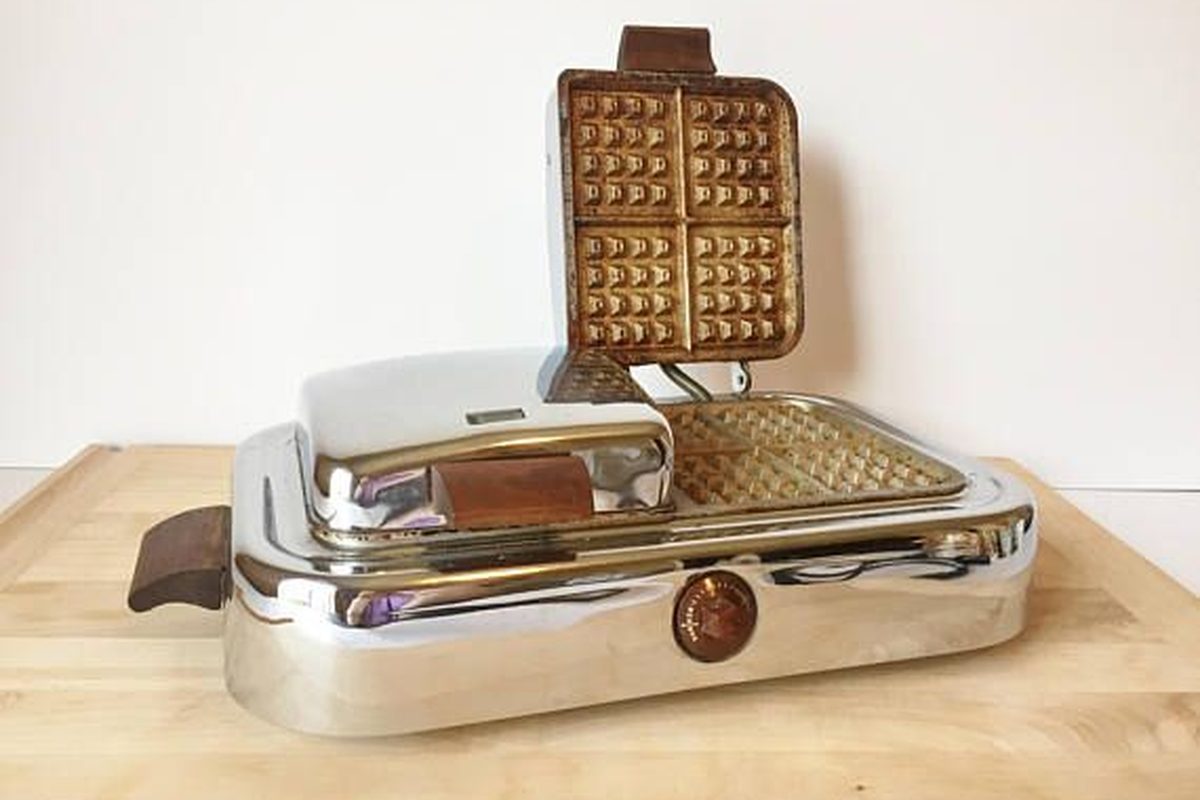
Nike did not begin with advertising campaigns and global stars. It began in the boot of a car. In 1964 the runner Phil Knight and his coach Bill Bowerman set up Blue Ribbon Sports to sell Japanese running shoes in America; Knight sold them out of his car at track meets.
The waffle iron that started it
Bowerman was not a salesman. He was a coach obsessed with making a lighter shoe that gripped better. In 1971, watching his wife make waffles, he had the thought: what if a sole carried the same raised square pattern?
He poured liquid urethane into the family waffle iron. The iron was ruined. The idea was not: the waffle sole became the company’s first real innovation.
The name and the logo
The Japanese partnership ended soon afterwards, and the company needed a name of its own.
- The name. Their first employee, Jeff Johnson, dreamt it: Nike, the Greek goddess of victory. Knight disliked it and wanted “Dimension Six”. He gave way at the last minute.
- The logo. A graphic design student, Carolyn Davidson, drew the Swoosh for $35. Years later the company gave her shares worth several hundred thousand.
The technology
Nike Air (1978). The idea came from Frank Rudy, a former NASA engineer: sealed units of pressurised gas set into the sole. Other companies turned him down. Nike did not. The first shoe to carry it was the Tailwind.
Air Max (1987). Tinker Hatfield, taking his cue from the Pompidou Centre, where the building’s workings are on the outside, made the technology visible and cut a window into the sole. People no longer had to take the air unit on trust.
Flyknit (2012). The whole upper knitted from a single yarn, like a sock. Very light, almost seamless, and far less waste in manufacture. It also allows support and ventilation to be built into the knit itself, zone by zone.
React (2017). A midsole foam built to hold together four qualities that normally pull against each other: soft, responsive, light, and durable. It appeared first in basketball shoes, then took over the running range.
Jordan, and the ban that sold the shoe
The 1984 deal with Michael Jordan was the turning point – not one shoe but a whole line, the Air Jordan. The first red-and-black pair fell foul of the NBA’s uniform rules and was banned.
Nike paid the fine for every game and ran the advert anyway: “The NBA threw them out of the game. Fortunately, the NBA can’t stop you from wearing them.”
The ban turned out to be the best campaign the shoe could have had, and the Air Jordan became a symbol of not doing as you are told.
“Just Do It”
The 1988 slogan became a global shorthand. Its origin is bleak: the advertising man Dan Wieden took it from the last words of a man executed in Utah – “Let’s do it” – and changed a single pronoun.
Why it has lasted
- It kept inventing – from the waffle iron to Flyknit and React.
- It told stories – Nike has never really been selling the shoe.
- It made belonging the product – wearing the mark is meant to place you inside something larger.
Questions I get asked about Nike
Is the window in the sole doing anything, or is it just for show?
The window is a view of the unit, not the unit. Sealed pressurised gas had been in the sole since the Tailwind in 1978; what Tinker Hatfield did in 1987 was cut the midsole open so you could see it. Nothing about how it cushions changed that year – what changed is that you no longer had to take it on trust. Where the unit sits matters far more than whether you can see it: one under the heel and one under the forefoot feel like different shoes.
React or ZoomX – which one am I actually buying?
Two different jobs. React is the everyday foam: it holds its shape over a lot of miles and it is the one in most of the running range. ZoomX is the light, bouncy racing material that sits around the plate in the fastest shoes, and it packs down far sooner. If you are buying one pair for all your running, you want the first. There is more on what the second is for in the carbon plate story.
Does a knitted upper hold up?
Better than it looks, with one caveat. Flyknit has very few seams, which is where uppers usually fail, and the knit can be made tighter where the foot needs holding and looser where it needs air. What it does not have is the layered structure of a stitched upper, so it gives a little more as it ages. On a shoe you run in, the midsole will be finished before the upper is.