

Puma and adidas were one company, one family and one small Bavarian town until 1948, when two brothers stopped speaking to each other and Herzogenaurach split down the middle. Puma is the half that got the sprinters, the footballers and, for a long time, the smaller share of everything else. This is the other brother’s story.
1948: Rudolf leaves
The Gebrüder Dassler Schuhfabrik – the Dassler Brothers Shoe Factory – had made sports shoes in Herzogenaurach since the 1920s, and made the spikes Jesse Owens wore in Berlin in 1936. Adolf was the craftsman; Rudolf, the elder, was the salesman. What finally broke them is still argued about; that they broke is not. In 1948 the brothers divided the business. Adolf’s half became adidas. Rudolf’s half, registered in Germany’s commercial register on 14 January 1949, was called Puma.
The town split with them – two factories, two football clubs, two sets of pubs – and for decades locals reportedly looked at a stranger’s shoes before deciding how to speak to him. The rivalry produced two of the largest sportswear companies in the world, half a mile apart, on opposite banks of the same river.
1968: the Suede and a raised fist
Puma’s most important shoe was made famous by something that had nothing to do with running in it. At the 1968 Olympics in Mexico City, Tommie Smith won the 200 metres and stood on the podium with a black-gloved fist raised, one of the century’s defining images. On his feet, and then in his hand, were Puma Suedes. The shoe became a symbol before it became a fashion object, and it has been in production, more or less unchanged, ever since.
Two years later came the episode the marketing textbooks still teach. Before the 1970 World Cup final, Pelé asked the referee for a moment, knelt, and tied his laces – Puma laces, on Puma King boots, in front of a global television audience. The brothers’ sons had supposedly agreed a truce not to sign him. Puma paid him to do it anyway. He then won the World Cup.
The long middle
For most of the decades after, Puma was a football and sprint brand with a fashion sideline and a distant third place in running behind Nike and its own estranged sibling. The ownership changed hands more than once: the French luxury group Kering took control in 2007, and in 2018 distributed most of its stake to its own shareholders, leaving the Pinault family’s holding company, Artémis, as the largest owner with about 29 per cent. In January 2026 Artémis agreed to sell that stake to China’s Anta Sports for €1.5 billion, a deal due to complete by the end of the year. Puma has spent much of its life being owned by someone else’s strategy.
2021: back to running, with nitrogen
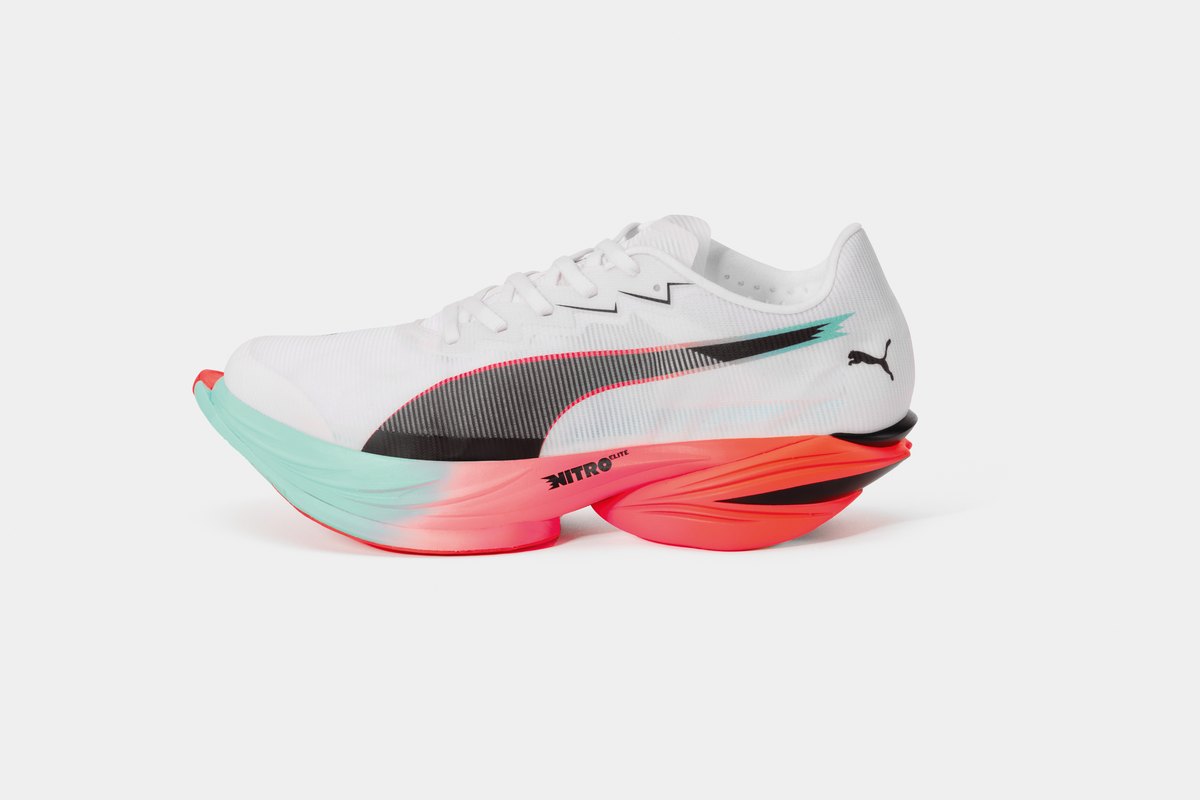
The running story restarted in 2021 with NITRO, a foam expanded with nitrogen rather than a chemical blowing agent, which gives a light, springy midsole for its weight. Paired with PUMAGRIP, a rubber that reviewers have found holds wet pavement unusually well, it produced the Velocity and Deviate lines and, for the first time in a generation, running shoes that specialists recommended without a caveat.
Puma is still headquartered in Herzogenaurach, a few streets from adidas, and still listed in Frankfurt. It remains the smaller brother. But the shoes it makes for runners are, as of the 2020s, genuinely good – which, given how long that took, is the most surprising turn in the story.
Questions I get asked about Puma
Is Puma a serious running brand now?
For the first time in a generation, yes. The NITRO foams arrived in 2021 and specialist shops started recommending the Velocity and Deviate without the caveat that used to follow the name. It took the company roughly fifty years to get back to this point, which is the most surprising turn in the whole story.
What is NITRO, in plain terms?
Foam blown with nitrogen instead of a chemical blowing agent. The gas gives a lighter, springier midsole for its weight. Paired with PUMAGRIP, the rubber reviewers keep finding holds wet pavement better than it has any right to, it is the combination that put the brand back in the conversation.
Is the Suede a running shoe?
No, and it never really was. It is the shoe Tommie Smith had on the podium in Mexico City in 1968, it has been in production more or less unchanged ever since, and it is a flat-soled street shoe. Lovely thing. Do not run in it.