

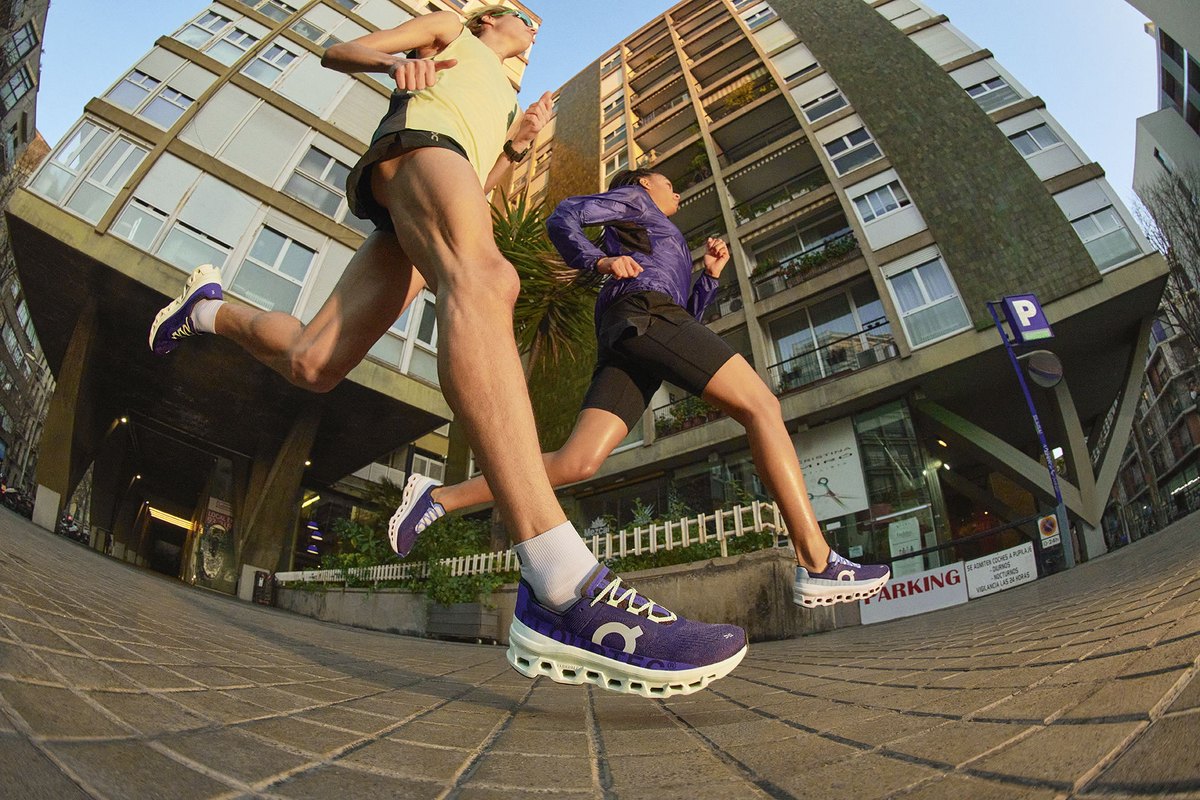
Every other brand on this site is older than the runners who wear it. On is not: it was founded in January 2010, in Zurich, by three friends and a garden hose. Eleven years later it was listed in New York at $7.3 billion. How a shoe that people either love or cannot stand got that far, that fast.
The hose
Olivier Bernhard was a Swiss professional triathlete – a multiple Ironman winner – who had spent a career being uncomfortable in other people’s shoes and wanted a landing that felt soft and a take-off that felt firm, two things foams did not offer at once. His first prototypes were exactly what the story says they were: pieces of garden hose, cut and glued to the underside of a sole. A hollow tube compresses when you land and locks solid when you push off. The idea worked well enough to be worth a company.
He founded it with David Allemann and Caspar Coppetti, two friends from marketing and consulting rather than from footwear, in January 2010. Within a month the hollow-pod sole – by then called CloudTec – had won an ISPO Brand New award, and by July the first shoes were in shops. No other running brand has gone from prototype to retail in six months.
Why it looks like that
The pods are the whole point, and they are also why On divides people. Because each one is hollow, the sole compresses in stages rather than all at once; because they are separate, the shoe flexes where the foot flexes. The feel is unlike a solid foam and is easy to like or to dislike immediately – which is why the models on this site carry the note that it is worth trying on before reading about. The pods also collect gravel, which every On owner discovers in the first week.
The brand’s other technology, the Helion superfoam, arrived later to do what the pods alone could not: give a soft, high stack for long miles. The Cloudmonster in the table here is that combination – big pods, Helion, and a ride nothing else in the list quite resembles.
Federer
The turning point in the brand’s public life came in 2019, when Roger Federer became an investor and co-owner. He had, by his own account, been wearing On shoes off-court for years; the partnership produced a tennis shoe and, more importantly, made a Swiss running brand a global name. It is hard to overstate how unusual this was. Athletes endorse shoes for money; Federer bought into the company.
New York, 2021
On listed on the New York Stock Exchange in September 2021 at a valuation of $7.3 billion, eleven years after the hose. It is the youngest brand in the table by more than half a century and the only one whose founders still run it. Zurich remains the headquarters.
The honest assessment is that On makes distinctive shoes at a premium price, and that the distinctiveness is real rather than decorative – the sole genuinely behaves differently, for better and for worse. Whether that difference is worth the money is a question the shoe answers within a hundred metres of trying it on. Few brands can say that, and none this young.
Questions I get asked about On
Do the pods really pick up stones?
Yes, and every owner finds out in the first week. On gravel and loose trail they catch small stones, which you then prise out with a key. On tarmac it is much less of a problem. It is a nuisance rather than a fault – the hollow shape that traps the stone is the same shape that makes the shoe feel the way it does.
Why do people either love them or hate them?
Because the sole genuinely behaves differently. Each pod is hollow, so it collapses in stages instead of all at once, and because they are separate the shoe bends where your foot bends. That is not a difference you have to take on faith; you feel it in the first hundred metres, and what you feel decides it. This is the one brand on the site I would not buy unseen.
Is it expensive because it is good, or because it is Swiss?
Some of both, honestly. The shoes sit at the top of the price range and the technology in them is real rather than decorative. Whether the difference is worth the money is not a question anyone can answer for you – but it is at least a difference you can test in a shop in two minutes.